Thursday, February 4, 2016

Electric Vocab


       What is electricity? Well electricity is an energy that is the result of a current.A current is a flow of electric charges. There are objects that let these charges flow, these objects are called conductors. The objects that don't let the charges flow are called insulators. The energy that flows into the objects are atoms. Atoms are the smallest particle of an element. An example of something that the electric charges go through is a circuit. A circuit is a path along which electrical charges are carried. Now you know what electricity is and how it can flow through things. 


Monday, February 1, 2016

Van de graff πŸ“πŸ™ŒπŸΌ

We played with an object  called  a Van De Graff. When you turn it on it starts to make a weird noise and as you get things close to it and makes electric shocks. Well not with every object just some. This happens because there are objects that let atoms flow freely(insulators)and there are other objects that don't let atoms flow freely (conductors). 
 I would like to try mousse on a Van De Graff. I'm curious of what would happen if you put a hair product near electricity. I think that the mousse will like "melt". 

Tuesday, January 26, 2016

Conductors vs Insulators

Today I have learned about conductors and insulators. An  insulator is the electricity can not flow freely and in a conductor the electricity can flow freely. 

An example of an insulator is dry air that means that the electricity we'll be hard to flow freely. An expample of a conductor is wood that means that the electricity well flow freely. When I say that the electricity flows freely I mean that the atoms of the object can observe electricity freely. 

Today, I had contact with dry air. The air is so dry because it's so cold the electricity can't flow freely. This dry air is an insulator. 

Today, I also had contact with rubber. When I touched it you can feel the electricity. How? Well sometimes when I touch it I feel like a shock on my finger. This happens because we have the same kind of electricity ( positive or negative). So when I touched the rubber with the same kind of electricity as me we repel. Because it's look magnets positive and positive will repel and negative and negative. πŸ˜ŠπŸ™ŒπŸΌπŸ‘ŒπŸΌ


Thursday, January 21, 2016

Electric Light


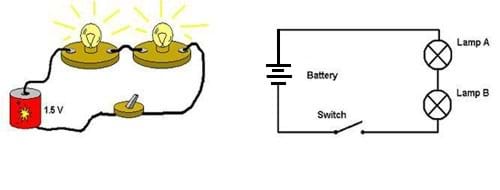
                  Today in class we had to light a bulb with a battery and a wire. Do you think it was possible? Well yea it was possible... first I tried and tried but I couldn't figure it out. Finally, I got it to light up... you have to put the metal part from the bottom of the blub touching one end of the metal of the battery, then when those two sides are touching you then you touch the other side of the battery with one side of the wire and the other side you touch where the battery is touching the bulb.

Thursday, December 17, 2015

Elastic vs. Inelastic

Do you know what elastic collision and Inelastic collision is? So if you don't know I will explain to you what each collision means and how both are different. 

Elastic collision- this collision is when two objects/people collide and they "bounce" off each other πŸ˜‰
Inelastic collision- this collision is when two objects/people collide BUT "stick together" πŸ™„
Well if you don't understand with the definition I'll give you an example; 
                         EXAMPLES;

     Elastic collision: An example of this collision in my life is when I play with a bouncy ball. I would rewind the ball to the wall and the ball would "bounce" off the wall back to me. This is an example because the wall and the ball are colliding but the ball is bouncing off. πŸ“πŸ‘ŒπŸΌ
Inelastic collision: An example of this collision in my life is when I was playin around with my bestie πŸ‘­ and I threw myself on her so I could pick her up and we stayed stuck together that I fell down with her on the floor. πŸ˜‚πŸ˜… but she didn't get mad. In this example the part of me falling in the floor with her is the Inelastic collision because we collided and we stuck together that we BOTH fell down.😝
Now if you still don't understnd hea r pics 
      Elastic Collision; πŸ‘€πŸ‘€


          Inelastic Collision; πŸ‘₯


Elastic Collisions

What is momentum? Well, if u don't know what it is I can explain it to you. Momentum is the force times the speed of an object. And you can compare momentums between objects. 

- What has a greater momentum; a train at stationary or a moving skateboard...

    Of course, the moving skateboard has a greater momentum.  You must be asking " but why if the train weighs more than a skateboard?" Blah blah blah... Yes it's true a train weighs more but in this case when you want to find momentum you need the objects force (kg) times the objects speed (m). So, the train is at rest which isn't moving and the skateboard is moving. So, in this case the skateboard has the most momentum because it's moving a weight. And the train is at rest not moving at all which isn't doing work for train to move its weight. πŸ˜ƒπŸ‘ŒπŸΌ✏️

Tuesday, December 15, 2015

Work vs Power

The difference between work and power is that work is is the amount of force you do on an object so it can move at a certain distance. And power is the rate of how much work you put on an object. 

To find work you ONLY need force x distance. 
And to find the power you need work/ change of time.  
For work time doesn't matter BUT in power time DOES MATTER. πŸ˜„πŸ‘ŒπŸΌ✖️➗

Examples; 

Work done nd lots of power- An example of someone doing work with lots of power is a weight lifter picking up a 50 pound weight above his head with the time of 3s. And the second weightlifter is lifting the same weight but at the time of 10s. Which weightlifter has more power?
Well the second weight lifter because it's takin him more time to lift the same weight at the same distance. 
The one with less time is an expanse of little power because he's not taking all of his power to lift the weight up.